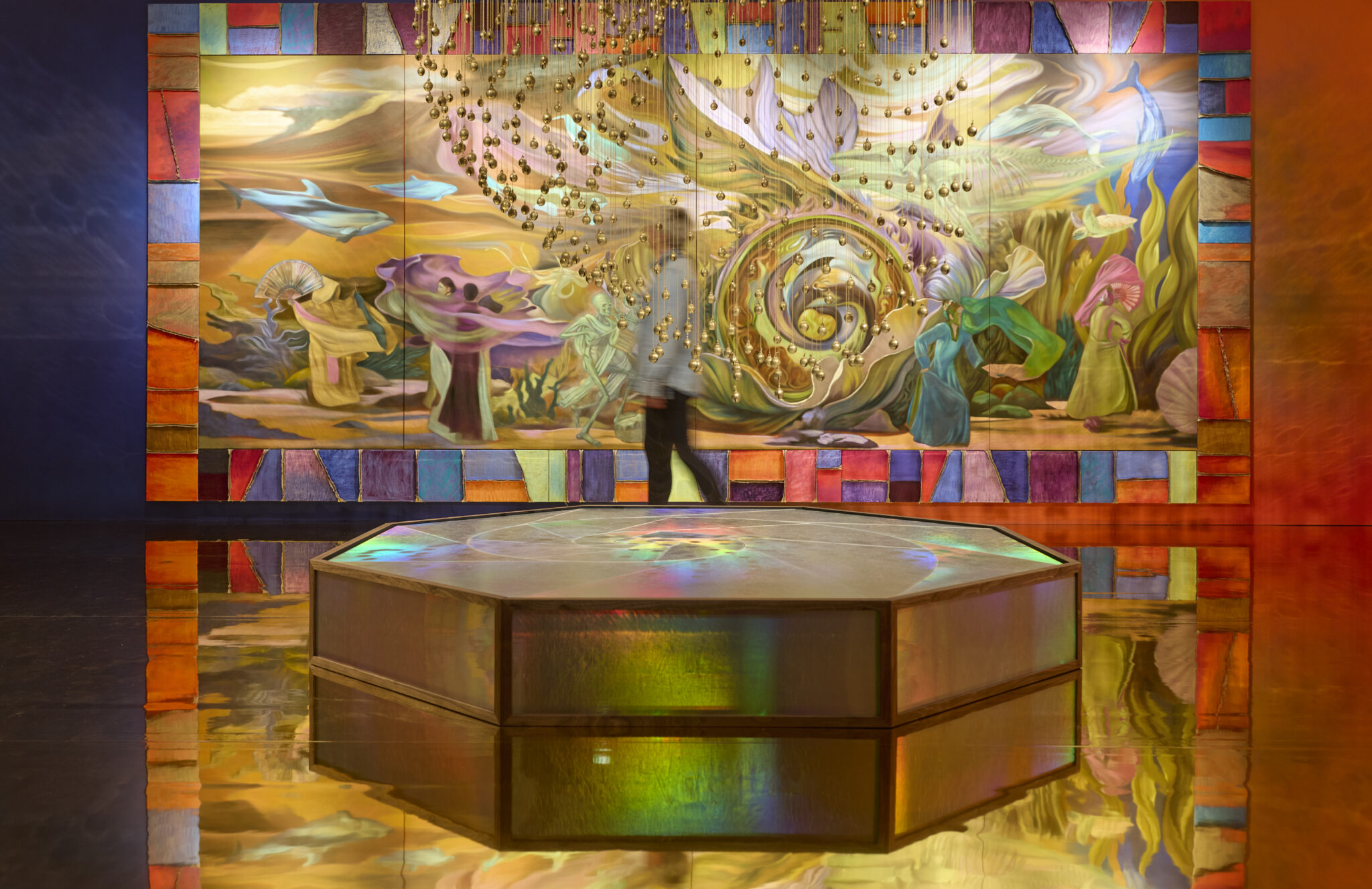
A large, high-ceilinged art gallery with polished wooden floors and white walls. Two oversized paintings hang on adjacent walls: on the left, a blue-toned underwater scene with jellyfish; on the right, a wide orange and yellow abstract landscape with green lines and textured details. Three visitors stand spaced apart, quietly viewing the artworks under bright overhead lights.
In conversation

Curating Turner Prize 2025: Griselda Pollock in conversation with Michael Richmond and Sophie Bullen

Journal 2 Mar 2026

Yorkshire Contemporary were thrilled to work in partnership with Bradford 2025 UK City of Culture, Tate and Bradford District Museums & Galleries, to co-curate the Turner Prize 2025. We want to thank everyone that put so much time and care into this project. It was a privilege to work with the four nominated artists, Nnena Kalu, Rene Matić, Mohammed Sami and Zadie Xa, and witness the curiosity, conversation and joy their exhibitions and events brought to the people living in and visiting Bradford. We loved welcoming over 83,000 visitors to see the presentations. As we move to our next chapter, we look forward to continuing to bring innovative and ambitious projects to the region.

As the exhibition closed, art historian and Yorkshire Contemporary Trustee Griselda Pollock spoke to Curator Michael Richmond and Assistant Curator Sophie Bullen about their experience of working on the exhibition, and some of the questions raised by the show.

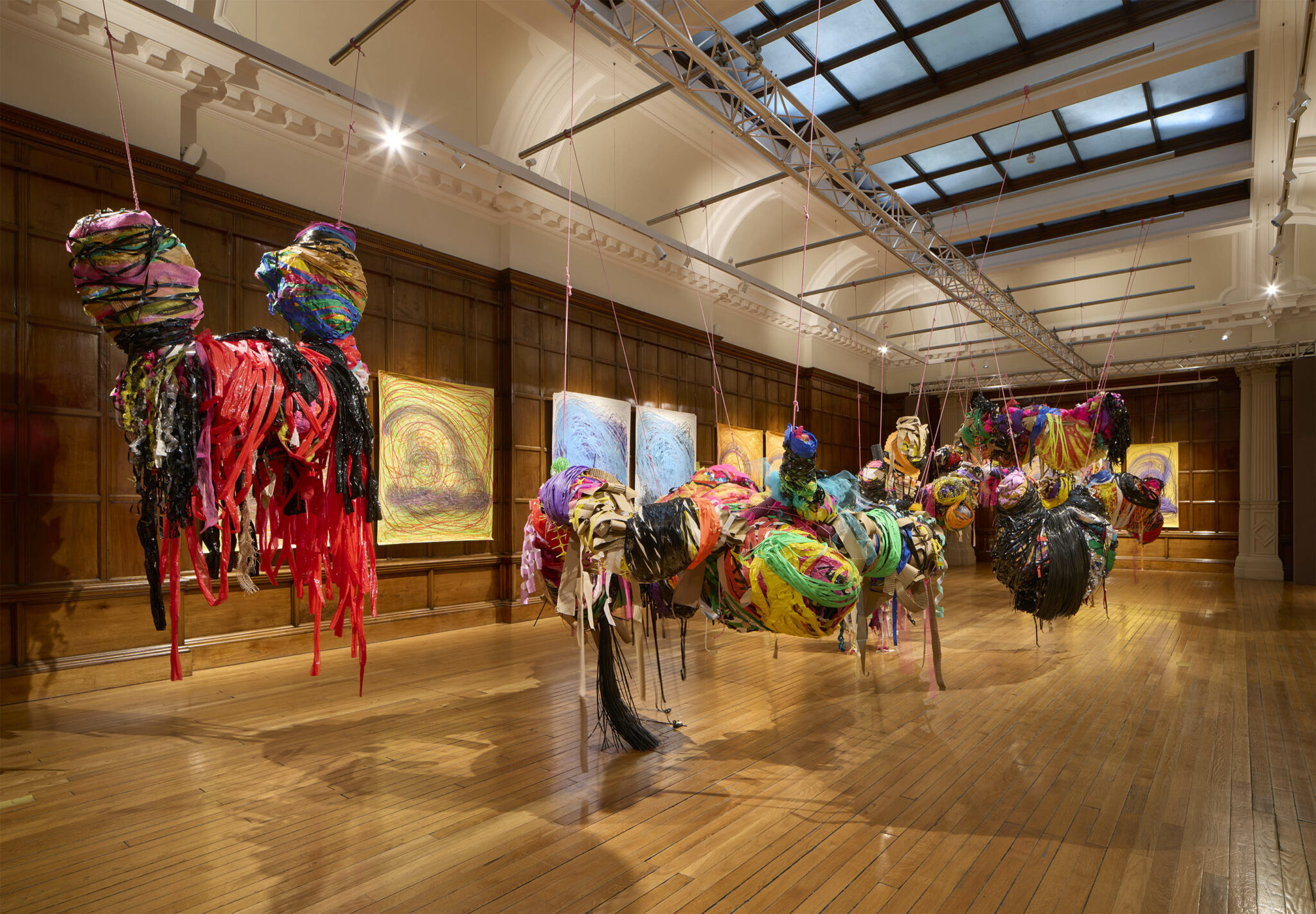
Installation view of Nnena Kalu’s presentation at Turner Prize 2025 in a wood-panelled gallery. Large, suspended sculptural forms made from brightly coloured, layered and wrapped materials hang from the ceiling, stretching across the room, with vibrant abstract paintings displayed on the walls behind them.
Nnela Kanu. Turner Prize 2025. Cartwright Hall Art Gallery. Bradford. Photograph by David Levene

Griselda Pollock: How did you decide the locations of each work and their relationship to this ornate Victorian building? As the exhibition reads very much as four distinct solo presentations intervening within these grand spaces, did you identify a logic or thread connecting the four artists as the exhibition took shape?

Michael Richmond: I’d say the Turner Prize required quite a different approach to how I’d usually curate a multi-room exhibition. Normally, I think of an exhibition as like an essay or a film. Instead of words, sentence structures or paragraphs – or casting, plotline and cinematography – we’re using artworks, groupings, and architecture to construct a visual narrative or argument. These techniques and devices, among many others, are then used throughout an exhibition to tell the story of an artist’s career or the history of a movement. 

With the competition format of the Turner Prize, there was no narrative we were trying to build in the same way, nor was there an inherent thread connecting the nominees. Alternatively, the aim for us was to re-stage the exhibitions the artists were nominated for. 

With the building, we were quite fortunate as Cartwright Hall has four galleries separated by its baroque central atrium. In theory visitors could choose where to start and finish, with the architecture giving each artist room to breathe and underscoring the fact that these are essentially four distinct exhibitions.

What we did have to consider was that each gallery has its own characteristics and crucially size which, in the interests of being fair, became the main factor in allocating galleries. This meant the only significant decision was which of the two larger upstairs galleries Mohammed Sami and Nnena Kalu would get, one being a ‘white cube’ space and the other clad in distinctive wood panelling. Talking it through with Mohammed and Charlotte Hollinshead, Nnena’s Artist Facilitator, we felt the wood panelled room was a unique space to showcase Nnena’s practice, where the works felt appropriately transgressive in such a formal setting. Meanwhile, Mohammed’s paintings had previously been exhibited amidst the grandeur of Blenheim Palace, hence a more contemporary setting seemed fitting, rather than trying to re-stage what had been done before.

The final piece of the puzzle was then placing individual artworks. We were very fortunate to be able to collaborate with the artists, their teams and technicians to find the right spaces. Whether it was Nnena’s sculptures or Rene’s photographs, we had a lot of fun working with the building to find the right spots.

Large beige fabric with the words
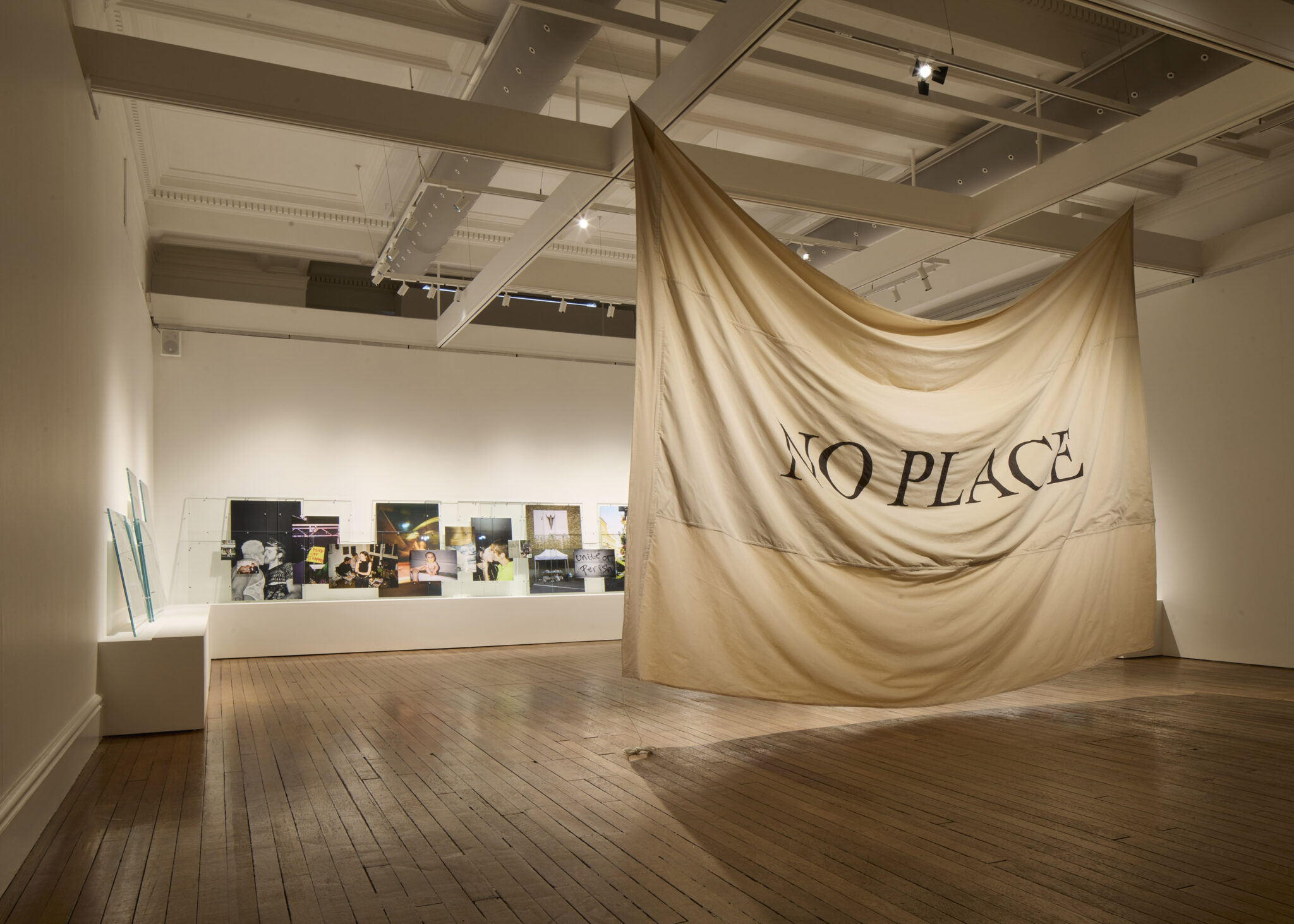
Installation view of Rene Matić’s presentation at the Turner Prize 2025, Cartwright Hall Art Gallery. Photo © David Levene

Griselda Pollock: Across the exhibition, the artists engage deeply with medium and process: binding and wrapping with found objects, painting at scale, practices of assembling and collecting, and intercultural dialogues articulated through material, colour, and form. To what extent do these works invite us to understand making as a site of pleasure, and to what extent do they expose its anxieties and uncertainties?

Sophie Bullen: Nnena Kalu’s work can enable us to understand an inherent urge to make. Nnena can’t verbalise what she’s thinking or how she’s feeling when she draws and sculpts, but it is clear this is something she wants or needs to do. Because of this, we’re not able to say what these works are about, but the intensity of her knot-like drawings have, to some visitors, suggested a sense of frustration or urgency. Similarly, the mass of bright tapes and plastics could elicit thoughts around consumerism or the abundance of plastic. However, whilst making her work, the sounds of disco music accompany her rhythmic swirling and wrapping, making it clear that joy shapes each work.

Rene Matić’s display shows the double-sided-ness of life. The intensity of the 24 hour news cycle and bombardment of information through the internet is suggested by the cacophony of sounds and images in their presentation. Some of Rene’s photographs portray scenes of illness, death, hate and war, whilst a soundtrack of protest, news and gunfire plays overhead. These images are, though, thoughtfully punctuated by those of love and intimacy: a karaoke performer, a baby in a bath, a kissing couple at a house party. Many of the images are taken at clear moments of happiness, showing how life moves through the full breadth of emotion. 

Zadie Xa’s presentation feels instantly joyful; on entering you are lifted by the glowing gold floor. Beautiful, magical images of dancers and marine life swell around you. Zadie’s work feels like it comes from a site of pleasure only; these large, luxurious oil paintings in bright pinks, blues and purples cradle the viewer. But moments in her presentation suggest a tension between this joy and the other aspects of life – skeletal human and sea creatures haunt the painting La Danse Macabre and elsewhere a parable plays about a young child’s entrapment. There’s a celebration of human and animal connection whilst also a warning: treat the world kindly and listen to non-human species.

Mohammed Sami’s paintings are grand. There’s something about painting, and painting at that scale especially, that suggests pleasure. The figure of the painter at the easel is embedded into romantic ideas about art-making. Mohammed’s paintings are set-like in scale, drawing the viewer into the scene. We are invited to decode, misconstrue and unpick a narrative within the works. This narrative contrasts with the beauty of the paintings: once deciphered they’re scenes of horror, brutality and ignorance about the realities of conflict.
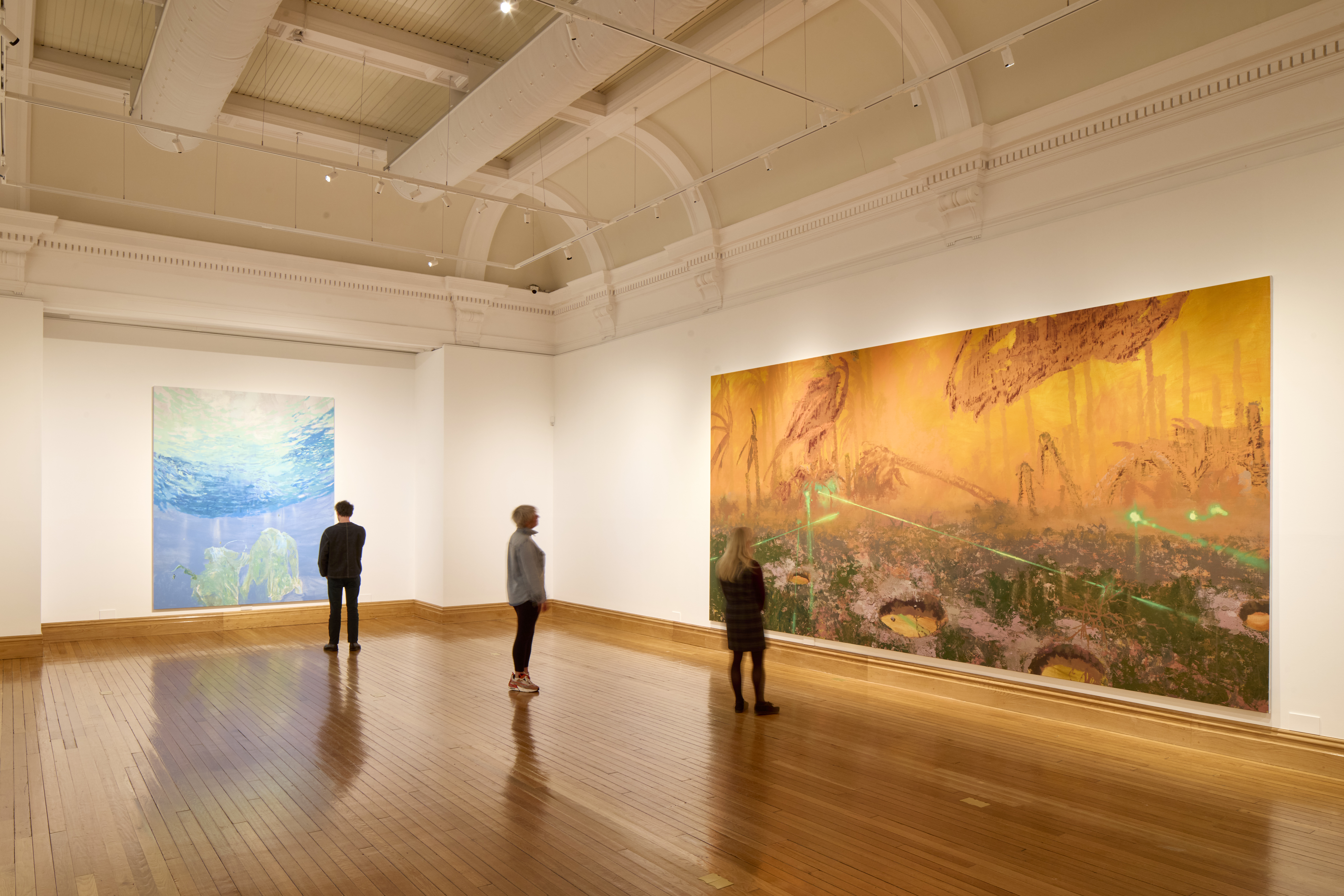
A person walks past a colorful, swirling mural with abstract figures and marine life, reflected on a gold shiny floor. In front, delicate, conch like shells dangle from the ceiling above a raised hexagonal plinth.The scene is vibrant and dreamlike.

Griselda Pollock: Each artist’s film – and, to an extent, the exhibition interpretation – locates their practice in relation to a historically or personally significant social identity, even while pointing to the instability or inadequacy of such identities. To what extent has the question of the artist’s identity become more prominent than the form or material processes of the works?

Michael Richmond: I don’t think identity has become more prominent, as ultimately the various qualities of the works have to stand for themselves. 

Where I think identity does become important, is in refining who has the ability to speak authentically or authoritatively to a particular topic or artistic process. Arguably great contemporary art speaks to the moment during which it was produced – the Turner Prize over the years is maybe the example par excellence here! All of this year’s nominees address urgent issues in one way or another, while speaking from a position of experience. To take an extreme counterexample, in 2017 painter Dana Schutz was criticised for depicting the corpse of Emmett Till, a Black boy who was brutally murdered in a racially-motivated attack in Mississippi in 1955. The episode raised questions about artists addressing subjects far removed from their own lived experience. Some argued that at best this kind of work is naïve or disingenuous, meanwhile at worst it’s exploitative cultural appropriation. In this regard, an artist’s identity can be key – perhaps increasingly so if we want art to address current political and societal topics – but the work still has to hold its own in other ways.

We had to balance these considerations in the exhibition interpretation. For each artist, we wrote two texts: a brief artist biography in the entrance hall and then a second text in each of the galleries about the artworks. In this latter text, we were very deliberate to not mention the artist’s identity unless we felt it was necessary to explain the subject matter. I recall one newspaper criticising the interpretation for not mentioning Nnena’s learning disabilities. We did in fact note this in the artist bio, but for the gallery text we can’t say that the works are about learning disability any more than we can say they’re about being female or Black, so we left this out.

The artist’s films on the other hand exist on a slightly different plane. They are more of a tool to introduce the artist, their background and practice, rather than to explain individual works. In that way some of them do naturally end up focusing on biography and identity – hopefully in a way that’s also helpful and illustrative!

______

Missed the exhibition or wish to revisit? Watch exhibition tours led by Co-Curators Jill Iredale, Bradford Museums & Galleries and Michael Richmond, Yorkshire Contemporary below, or view the Virtual Tour.


Nnena Kalu, Curator's Tour

Nnena Kalu, Curator's Tour

Rene Matic, Curator's Tour

Rene Matic, Turner Prize 2025, Curator's Tour

Mohammed Sami, Curator's Tour

Mohammed Sami, Curator's Tour

Zadie Xa, Curator's Tour